

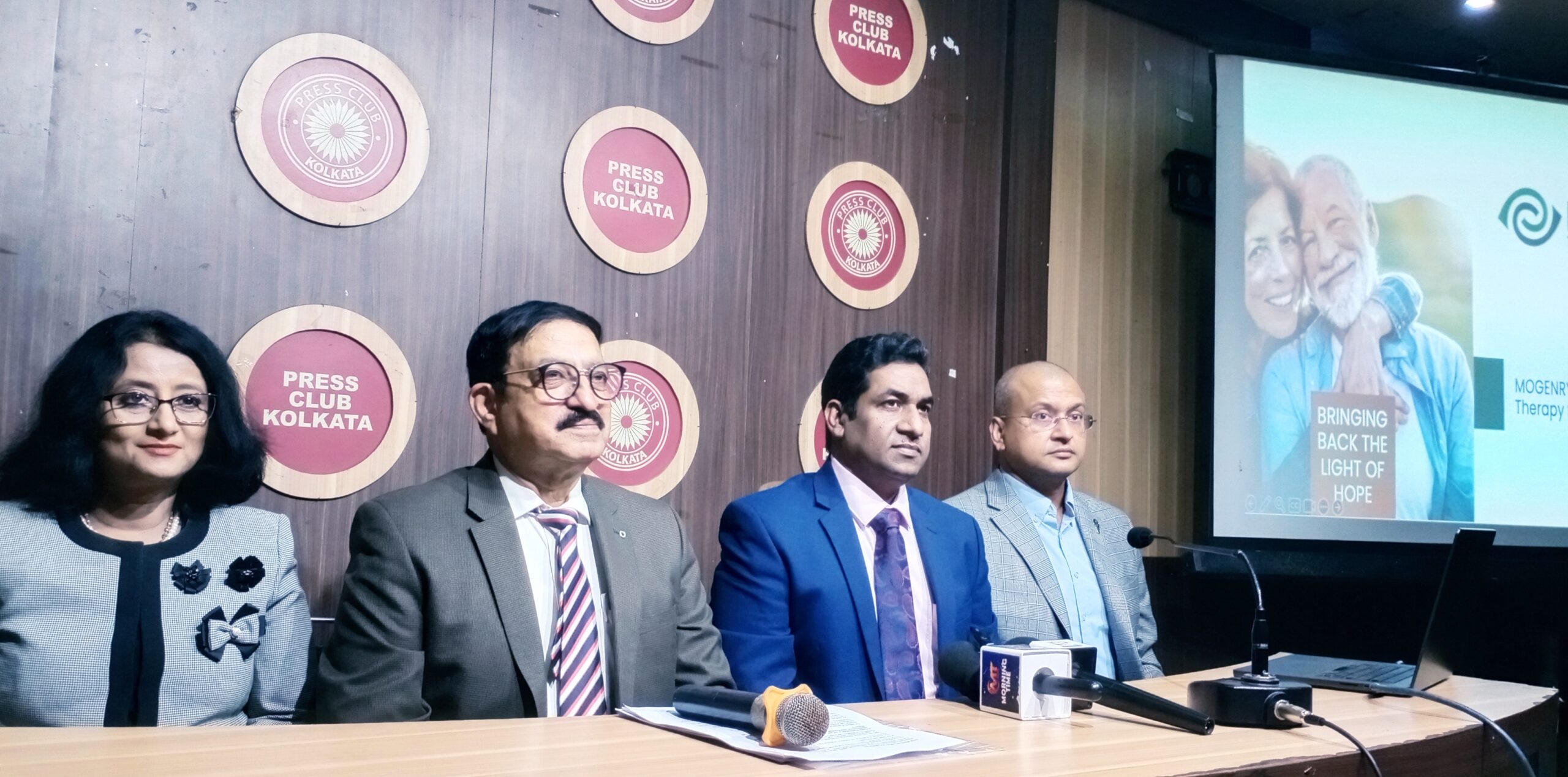
Kolkata: Nanoscope Therapeutics highlighted the potential of MOGENRY (MCO-010), an investigational, one-time, gene-agnostic optogenetic gene therapy developed to restore functional vision in patients affected by severe retinal diseases. The initiative brought together leading ophthalmologists, researchers, and industry professionals to discuss emerging advancements in gene therapy and their potential to transform the treatment landscape for patients with progressive vision loss.
The programme was attended by Dr. Partha Biswas, Immediate Past President of AIOS, and Director of Trenetralaya Eye Hospital and Netralayam in Kolkata; Dr. Samarendra Mohanty, President, Chief Scientific Officer and Co-Founder of Nanoscope Therapeutics; Dr. Santosh Mahapatra, Vitreo-Retinal Surgeon and Chief Medical Officer of JPM Rotary Eye Hospital in Cuttack; and Sulagna Bhattacharya, CEO and co-founder of Nanoscope Therapeutics.
Dr. Santosh Mahapatra, Principal Investigator of the Ph1/2a pilot study, conducted at JPM Rotary Eye Hospital in Cuttack, spoke about his experience on the effectiveness and long-term safety of the investigational product.
Speaking on the development, Dr. Partha Biswas, Past President of AIOS, said, “Retinal diseases such as Retinitis Pigmentosa pose a significant challenge because they progressively damage the light-sensitive cells of the eye, often leading to severe vision impairment and blindness. The development of innovative approaches such as optogenetic gene therapy offers an encouraging new direction in ophthalmology. What makes MOGENRY particularly interesting is its gene-agnostic approach, which has the potential to benefit patients irrespective of the specific genetic mutation responsible for their condition. While regulatory clearances are pending, such scientific advancements could open new possibilities for patients who currently have no treatment options.”
MOGENRY uses an innovative optogenetic approach that enables surviving retinal cells to become sensitive to light. Unlike conventional gene therapies that attempt to correct a specific faulty gene, the treatment delivers a light-sensitive gene into surviving retinal cells through a one-time injection. These modified cells can now detect light and transmit visual signals to the brain, potentially compensating for the loss of damaged photoreceptors.
Retinitis Pigmentosa (RP) is an inherited retinal disorder that causes progressive deterioration of vision and can eventually lead to blindness. Approximately one in 4,000 people worldwide and one in 1,000 people in India are affected by the condition, highlighting the need for treatment.
Dr. Samarendra Mohanty and his team at Nanoscope Therapeutics have been advancing optogenetic solutions to address retinal diseases. The company’s research and clinical development efforts reflected the growing potential of gene-based technologies in addressing conditions for which treatment options have historically remained limited.
The interaction provided an opportunity to highlight the importance of scientific innovation, clinical research, and emerging gene therapies in creating new possibilities for people living with severe retinal disorders.